
Getting a two-wheeler driving licence is the first step for many Indians who want to ride legally on public roads. With more than 20 crore registered two-wheelers in India, bikes and scooters remain the most popular mode of transport. Knowing the correct process, fees, rules, and test system helps you avoid mistakes and saves time.
This guide explains everything you need to know about getting a two-wheeler driving licence in 2026.
DL Stuck in Sarathi Pending Queue? Here’s How to Check Status in 2026
Two-Wheeler Driving Licence in India
A two-wheeler driving licence is an official government document that allows you to legally ride motorcycles and scooters on Indian roads. It is issued by the Regional Transport Office (RTO) under the guidelines of the Ministry of Road Transport and Highways through the Parivahan system.
Anyone who rides a bike, scooter, or moped on public roads must have a valid licence. Riding without a licence can lead to fines of ₹5,000 or more under the Motor Vehicles Act, 2019.
A separate two-wheeler licence is useful because:
- It proves your driving skill and legal status
- It helps in insurance claims
- It is accepted as an ID document
- It reduces legal risks during police checks
- It allows you to upgrade to higher vehicle categories later
For students, office workers, delivery partners, and daily commuters, a two-wheeler licence is often the first and most important transport document.
Types of Two-Wheeler Licence in India
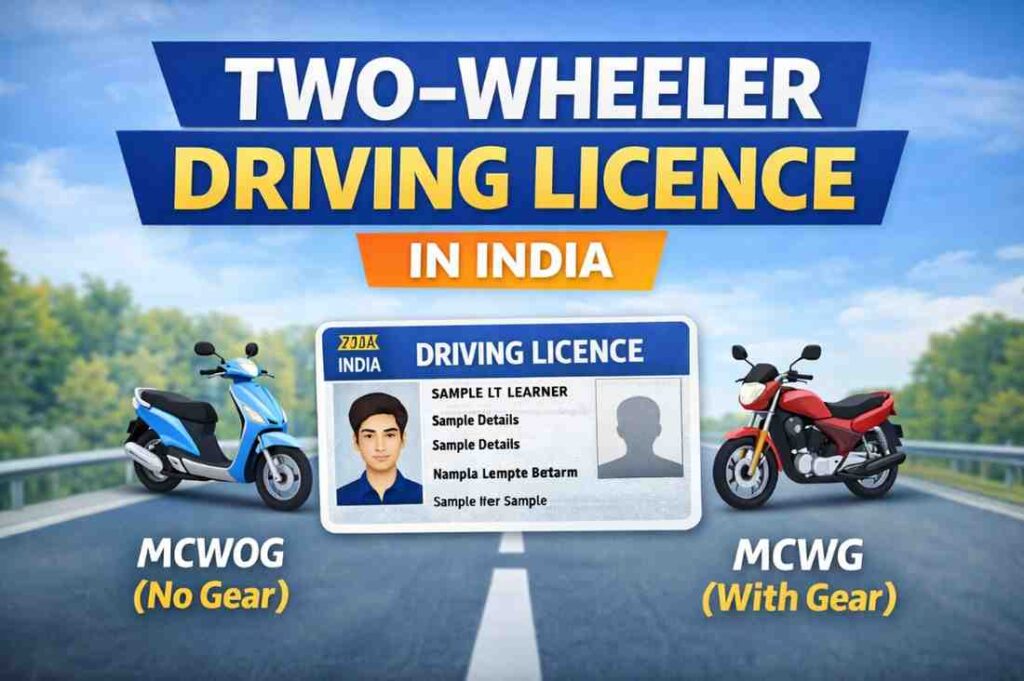
In India, two-wheeler licences are divided into two main categories based on gear system.
MCWOG (Motorcycle Without Gear)
MCWOG is for gearless vehicles such as:
- Scooters (Activa, Jupiter, Access)
- Mopeds (TVS XL)
- Electric scooters without gears
This licence allows you to ride only automatic or gearless vehicles. You cannot ride geared motorcycles with this licence.
It is mostly taken by beginners and young applicants between 16–18 years.
MCWG (Motorcycle With Gear)
MCWG is for geared motorcycles, such as:
- Splendor, Pulsar, Apache
- Royal Enfield
- Sports bikes
- All manual bikes
With MCWG, you can ride both geared and gearless two-wheelers.
This is the most common and useful category for long-term riders.
Key Difference Table
| Category | Vehicle Type | Gear System | Can Ride Scooter? | Can Ride Bike? |
|---|---|---|---|---|
| MCWOG | Scooters/Mopeds | No Gear | Yes | No |
| MCWG | Motorcycles | With Gear | Yes | Yes |
Choosing the correct category is important because wrong selection can lead to application rejection.
Eligibility Criteria for Two Wheeler DL
To apply for a two-wheeler driving licence, you must meet age and legal requirements.
Age Eligibility Table
| Category | Minimum Age |
|---|---|
| Without Gear (MCWOG) | 16+ years |
| With Gear (MCWG) | 18+ years |
Additional Rules
- Applicants below 18 years must submit parental/guardian consent
- Must hold a valid Learner Licence (LL)
- Must be physically fit to ride
- Must pass the driving test
For MCWOG applicants aged 16–18, Form 2 and Form 1A are required with guardian signature.
Without meeting these rules, your application will not be accepted.
Documents Required
Before applying, keep these documents ready in original and scanned format:
Mandatory Documents
- Aadhaar Card (preferred ID)
- Address Proof (Voter ID, Passport, Utility Bill)
- Age Proof (Birth Certificate, 10th Marksheet)
- Passport Size Photograph
- Digital Signature
- Learner Licence Copy
Optional (If Required)
- Medical Certificate (Form 1A)
- Parent Consent Form (Under 18)
All documents must match your application details. Even small spelling mistakes can cause rejection.
How to Apply Two Wheeler DL Online (Step-by-Step)
You can apply online through the government Parivahan portal. Follow these steps carefully.
Step 1: Visit Parivahan Website
Go to: https://sarathi.parivahan.gov.in
Select your state.
Step 2: Login/Register
Register using:
- Mobile number
- Aadhaar (optional but recommended)
Verify using OTP.
Step 3: Select “Two Wheeler Only”
Choose “Apply for Driving Licence” and select:
- MCWOG or MCWG
Step 4: Enter Learner Licence Number
Enter:
- LL Number
- Date of Birth
System will fetch your data.
Step 5: Fill Application
Provide:
- Address
- Blood group
- Emergency contact
- Vehicle class
Step 6: Upload Documents
Upload scanned copies in JPG/PDF format (size under 500 KB).
Step 7: Book Test Slot
Select:
- RTO
- Date
- Time slot
Early morning slots are easier to get.
Step 8: Pay Fees
Pay via:
- UPI
- Debit Card
- Net Banking
Step 9: Download Receipt
Save:
- Payment receipt
- Application form
Bring them on test day.
Two Wheeler Driving Licence Fees 2026
Here are the official fees followed in most states.
Fee Table (2026)
| Service | Fee |
|---|---|
| Learner Licence (LL) | ₹200 |
| Driving Test | ₹300 |
| Smart Card | ₹200 |
| DL Issue | ₹200 |
| Duplicate DL | ₹200 |
Average Total Cost
For new applicants:
LL + Test + DL + Card =
₹200 + ₹300 + ₹200 + ₹200 = ₹900
Some states may charge ₹50–₹100 extra as service fees.
Two Wheeler Driving Test Process
After booking the slot, you must appear for the driving test.
1. 8-Shape Test
You must ride in a figure-8 pattern without touching lines or putting feet down.
This checks:
- Balance
- Steering control
- Coordination
2. Balance Check
Inspector observes:
- Smooth start
- No sudden jerks
- Proper clutch use (MCWG)
3. Road Test
You may be asked to ride on public roads to test:
- Lane discipline
- Indicator use
- Traffic sense
4. Inspector Rules
- Helmet compulsory
- Vehicle documents required
- No mobile usage
- No rash riding
Tips to Pass
- Practice 8-shape daily
- Use familiar bike
- Stay calm
- Look straight, not down
- Maintain steady speed
Failing requires re-booking and paying ₹300 again.
How Long Does It Take to Get Bike Licence?
The complete timeline usually looks like this:
Typical Timeline
| Stage | Time |
|---|---|
| LL Issue | 3–7 days |
| Waiting Period | 30 days |
| Test Booking | 1–2 weeks |
| Test Result | Same day |
| DL Delivery | 10–20 days |
Total Time
From LL to DL: 2–4 weeks after test
Full process: 45–60 days
You can track status online using application number.
Common Problems & Solutions
This section helps you avoid delays.
Slot Not Available
Problem: No test dates visible.
Solution: Check at 6–8 AM, try nearby RTO.
Test Failed
Problem: Failed 8-shape.
Solution: Practice and rebook after 7 days.
Payment Failed
Problem: Amount deducted, not updated.
Solution: Wait 24 hours, contact bank/RTO.
Wrong Vehicle Class
Problem: Selected MCWOG instead of MCWG.
Solution: Apply for class addition (₹500).
LL Expired
Problem: LL validity crossed 180 days.
Solution: Apply for new LL.
Fixing these early saves weeks of delay.
Can You Upgrade to Car Licence Later?
Yes, after getting a two-wheeler licence, you can upgrade to LMV (Light Motor Vehicle) for cars.
Upgrade Process
- Apply for LMV Learner Licence
- Wait 30 days
- Book car driving test
- Pay ₹500 (class addition)
- Pass test
- Updated DL issued
Benefits
- Same DL card
- No need for fresh ID
- Faster processing
- Valid for both bike and car
Most riders upgrade within 1–2 years.
Important Tips for Applicants
Follow these practical tips:
- Practice at least 30 minutes daily
- Reach RTO 30 minutes early
- Carry original documents
- Wear helmet (ISI certified)
- Use your own bike
- Check tyre pressure
- Avoid nervous riding
- Eat light before test
Small mistakes like forgetting helmet or documents can cancel your test.
FAQs
Can I apply without learner licence?
No. LL is mandatory. Without it, DL application is rejected.
Can I ride geared bike with MCWOG?
No. MCWOG allows only gearless vehicles. Riding geared bike is illegal.
Is Aadhaar mandatory?
No, but Aadhaar makes verification faster. Other IDs are accepted.
How many times can I retake test?
There is no fixed limit, but each attempt costs ₹300.
Can I use friend’s bike for test?
Yes, if it has valid RC, insurance, and PUC.
Is helmet compulsory in test?
Yes. Without helmet, you are not allowed to take the test.
Conclusion
Getting a two-wheeler driving licence in India in 2026 is a structured and transparent process. From choosing the right category (MCWOG or MCWG) to clearing the driving test and paying around ₹900 in total fees, every step is clearly defined.
With proper preparation, correct documents, and regular practice, most applicants can get their bike licence within 45–60 days. This licence not only makes you a legal rider but also opens doors for future upgrades like car licences.