
A Vehicle Fitness Certificate (FC) is an official document which is issued by the Regional Transport Office (RTO) that certifies that a motor vehicle is “fit” meaning safe and suitable for driving on public roads. It verifies that the vehicle meets required safety standards (for brakes, lights, engine, tyres, suspension etc.) and emission or pollution norms.
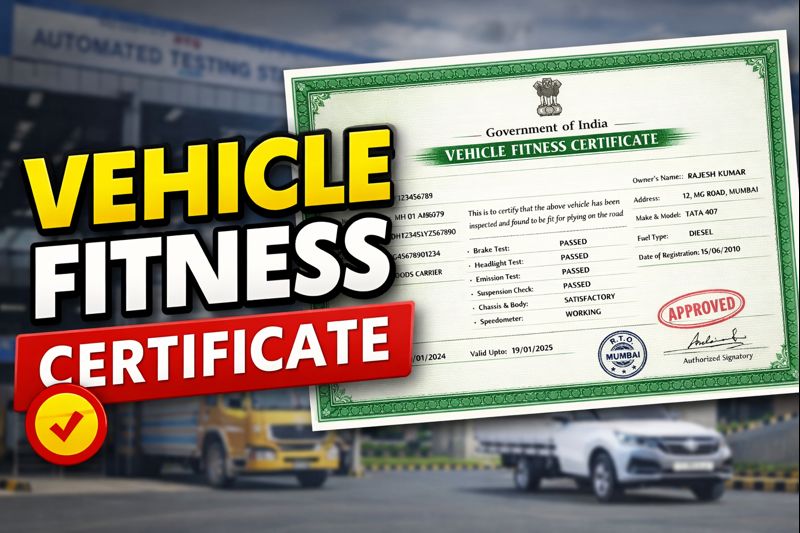
In other words, FC shows that your vehicle is road-worthy: its mechanical condition is sound, its emission is under required limits, and overall it meets the norms defined by law to protect road safety and environment.
Without FC, a vehicle may be considered unsafe or illegal to drive especially for commercial vehicles. That makes FC not just a formal document, but a proof of safety and compliance.
Parivahan Quick Actions (Official Links)
Use official government portals and apps for driving licence and vehicle related services.
This is an informational website. All buttons redirect to official government platforms.International Driving Licence (IDL): Complete Guide, Rules, Fees, Validity, and How to Apply Online
Why is a Fitness Certificate Important
Having a valid FC is important for many reasons legal, safety, environmental, and practical.
- Legal compliance: Under rules governing vehicles in India, a valid FC is mandatory for vehicles. Driving without it is an offense.
- Safety of people: The inspection for FC checks key systems brakes, lights, engine, tyres, suspension to ensure the vehicle is safe to carry passengers or goods. This helps prevent accidents that occur because of mechanical failures.
- Control pollution: FC also checks vehicle emission levels, ensuring that older or malfunctioning vehicles do not emit excess pollution. This helps protect environment and public health.
- Insurance and legal validity: Many insurers require a valid FC to cover a vehicle. Without FC, insurance claims may be denied. Also, other documents like registration may depend on a valid FC.
- Peace of mind for owner and passengers: Knowing that your vehicle is certified as road-worthy and safe gives confidence for you as a driver, and for everyone traveling in your vehicle.
In short: FC is not just paperwork it’s an important safety and compliance certificate.
Who Needs a Fitness Certificate Which Vehicles Are Covered
The requirement for Fitness Certificate depends on the type of vehicle and its use. Broadly:
- Commercial / transport vehicles such as buses, trucks, goods carriers, taxis must have a valid FC. This ensures they are safe to carry passengers or heavy loads, and comply with safety and emission norms.
- Private vehicles (cars, bikes, light vehicles) for new private vehicles, initially a fitness certificate is issued. After a certain age, renewal of FC may be required.
- Old or aging vehicles As vehicles age, their components wear out and emission levels may rise. To ensure old vehicles remain safe and environmentally compliant, FC and periodic inspections are essential.
Therefore, whether you own a two-wheeler, a family car, or a commercial vehicle you should check if FC is required. Especially for commercial vehicles, FC is mandatory without exception.
Validity Period How Long Does FC Last, and When to Renew
The validity of a Fitness Certificate depends on the type of vehicle (private or commercial) and its age.
- For new private vehicles (car or two-wheeler), the Fitness Certificate is usually valid for 15 years after registration.
- After 15 years, FC needs renewal periodically typically every 5 years, for private vehicle.
- For commercial vehicles (transport vehicles), the rules are stricter:
- In many states, a new commercial vehicle gets FC valid for 2 years initially.
- After the vehicle becomes older (for example over 8 years), annual renewal may be required meaning FC must be renewed every year.
Because of these rules, vehicle-owners need to track FC expiry carefully and renew on time. Driving on expired FC can lead to legal trouble see next sections.
What Documents and Requirements Are Needed for FC
To apply for a Fitness Certificate (or its renewal), certain documents and conditions must be met. These typically include:
- Original Vehicle Registration Certificate (RC) proof that the vehicle is registered.
- Valid Insurance Certificate for the vehicle to ensure the vehicle is insured as per law.
- Pollution Under Control (PUC) Certificate to show that vehicle’s emissions are within allowed norms.
- Recent road tax payment receipt (if applicable).
- Proof of identity/address of owner (such as Aadhaar, passport etc.) depending on RTO requirements.
- Vehicle details: chassis number, engine number, and sometimes a pencil impression of the chassis for verification.
- For transport vehicles: any permit or permit renewal documentation, depending on vehicle type.
- Passport-size photograph (owner or vehicle, as required).
Make sure all documents are valid and up-to-date. Missing or incorrect documents may result in rejection of FC.
How to Apply for Fitness Certificate Online and Offline Methods
You can apply for FC either online (via official portal) or offline (by visiting RTO). Both are allowed.

Online Method (via portal)
Step 1: Enter Vehicle Registration Number
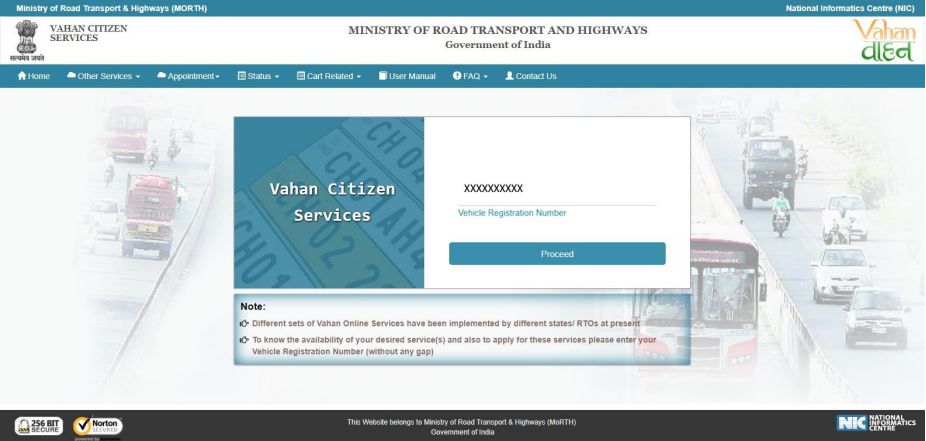
On the home page, the applicant enters the vehicle registration number to start the “Application for Fitness Certificate” service.
Step 2: Click the Proceed Button
After entering the number, the applicant clicks the Proceed button to move to the next stage.
Step 3: Select Fitness Certificate Service
From the “Online Services” menu, the applicant selects the “Fitness Certificate” option.
Step 4: Enter Chassis Number and Mobile Number
The system asks for the chassis number and the applicant’s mobile number. Both must be entered correctly.
Step 5: Click on Generate OTP
After filling in the details, the applicant clicks the “Generate OTP” button.
Step 6: OTP is Sent to Mobile
An OTP is generated and sent to the mobile number entered by the applicant. A pop-up will also confirm that the OTP has been sent.
Step 7: Enter the Received OTP
The applicant enters the OTP received on their mobile to verify identity.
Step 8: Click on Show Details
After entering the OTP, the applicant clicks the “Show Details” button to view the vehicle information.
Step 9: Fill Application Data and View Fee Details
The applicant fills in all required data and enters valid insurance details. The system displays the applicable fees. After reviewing, they click on the Payment button.
Step 10: Confirm to Continue
A confirmation message box appears. The applicant confirms to move the application to the next stage.
Step 11: Open Online Fee Payment Gateway
The system opens the payment gateway page. The applicant selects the “SBIePAY” option for online payment.
Step 12: Select Bank and Accept Terms
A list of banks linked with SBIePAY is shown. The applicant selects their bank, accepts the terms and conditions, and clicks on the Payment button.
Step 13: Proceed Through Bank Page
The applicant again clicks the Proceed button to continue with the selected bank.
Step 14: Continue Payment on Bank Gateway
On the payment page, the applicant chooses the “Pay Now” option.
Step 15: Complete Transaction
On the confirmation screen, the applicant chooses the “Successful” option to complete the transaction.
Step 16: Fee Receipt Generated
If the bank status shows success, the transaction is approved and the fee receipt is automatically generated.
Step 17: Print the Application Letter
The system generates the application letter. The applicant can now print or save it as required.
Offline Method (Through RTO Office)
If online facility is not available or you prefer offline, you can:
- Visit your nearest RTO office.
- Get the required application form (often Form 20 for non-transport vehicles, Form 38 or other relevant form for transport/commercial vehicles).
- Fill the form, attach required documents (RC, insurance, PUC, identity proof, etc.), and pay the required fees at the counter.
- Provide your vehicle for physical inspection on the scheduled date. RTO inspector will examine mechanical condition, emission, safety features etc.
- If inspection passes FC is issued; otherwise you must rectify defects and reapply.
Thus, FC application is flexible you can choose online or offline based on convenience and local RTO support.
What Happens During Vehicle Inspection What Is Checked
When you take your vehicle for inspection at RTO for Fitness Certificate, the inspector checks multiple aspects to ensure the vehicle is roadworthy and pollution-compliant. These checks are important for safety of passengers, driver, and others on road. Key checkpoints are:
- Engine and emission system: The engine must be in proper working order and emission levels (smoke, pollutants) must be within allowed limits. This ensures environmental compliance and reduces pollution
- Brakes, steering, suspension and tyres: All safety-critical parts like brakes, steering mechanism, suspension system, tyres these must be in good condition to avoid accidents
- Lights, indicators, mirrors and horns: Proper lights, indicators, mirrors, horns and other safety features must work they ensure visibility, signalling, and safety on road.
- Structural condition / body condition: Vehicle’s body condition no major damage, no rust or unsafe modifications is checked. Especially important for older vehicles or heavily used commercial vehicles
- Verification of vehicle identity: Chassis number, engine number, registration, paperwork inspector verifies that the vehicle matches its registration details and documentation
If the vehicle fails any of these checks, it will not get the fitness certificate until defects are fixed. That is why it is important to maintain vehicle properly before inspection.
Cost of Fitness Certificate & Recent Changes (Fees, Age-Based Slabs)
The cost (fee) for obtaining or renewing a Fitness Certificate can vary depending on vehicle type, age, and whether inspection is manual or automated.
As per recent updates (2025), the government introduced a new age-based fee structure under revised rules.
Here are typical fee examples (may vary by state):
- Two-wheelers: for manual inspection a certain lower fee; for automated inspection higher fee.
- Light Motor Vehicles (LMV) / Cars: fee is more than two-wheelers.
- Heavy and Medium Commercial Vehicles: highest fees (due to size, load and inspection complexity).
Because of recent rule changes, fees for older vehicles especially those beyond 15 or 20 years have increased significantly, to discourage heavily polluting or unsafe older vehicles from continuing on road.
So, before applying for FC (or renewing it), always check the current fee structure applicable to your vehicle type and ag
Penalties and Risks for Driving Without a Valid FC
Driving a vehicle without a valid or validly renewed Fitness Certificate is risky legally, financially, and in terms of safety. Some of the consequences include:
- Fines / Penalties: If you are caught driving without FC (or with expired FC), traffic authorities may impose fines.
- Vehicle may be impounded: For commercial vehicles especially, authorities may seize or impound the vehicle since operating without FC is illegal.
- Insurance invalidation: Insurance companies may deny claims if the vehicle does not have a valid FC. This means in case of accident, you may face heavy expenses.
- Increased risk of accidents and breakdowns: Without periodic inspection and fitness checks, mechanical failures or bad emissions may go unnoticed risking safety of driver, passengers, and other road users.
- Environmental harm: Older or faulty vehicles may emit excessive pollution; driving without FC contributes to air pollution and public health risk.
Because of these risks, it is important to ensure your vehicle always has a valid FC and renew it on time when required.
What Vehicle Owners Should Do Tips and Best Practices
To ensure smooth compliance and avoid trouble, vehicle owners should follow some good practices around Fitness Certificate.
- Keep track of FC validity: Note down the date when FC was issued and its expiry date (especially for commercial vehicles with shorter validity). Set reminders before expiry so you can renew on time.
- Maintain your vehicle properly: Regular servicing, checking brakes, lights, exhaust and tyres will help your vehicle pass fitness inspection without surprises. Don’t wait till last minute to fix issues.
- Keep mandatory documents ready: RC, insurance papers, PUC, road-tax receipt, identity proof keep valid and updated. Before inspection or renewal, gather all documents to avoid rejection.
- Use online application if available: If your state / RTO supports online FC application, use it it saves time, reduces paperwork, and may allow you to book inspection slots easily.
- Plan inspection and avoid delays: For commercial vehicles, which need frequent renewals, plan ahead. Avoid operating the vehicle once FC is expired to avoid fines and risks.
- Stay updated with fee changes and rules: As governments revise rules and fees (for example age-based fee slabs), check latest updates so you aren’t caught off guard by higher charges.
- Don’t skip emission / pollution test (PUC): Pollution norms are part of fitness checks. Keep PUC certificate valid if required.
Being a responsible vehicle owner means not only owning vehicle but also ensuring it stays safe, legal and environmentally complian